
A replacement pane that is off by even a small amount can delay your repair, leave gaps around the glass, or simply fail to fit. Learning how to measure replacement window glass helps you communicate clearly with a glazier, especially when a window is fogged, cracked, or letting in cold air. But safety comes first: if glass is broken, loose, or exposing your home or business to the weather, secure the area and arrange professional help rather than trying to measure around sharp edges.
Know What You Are Measuring Before You Start
“Window glass” can mean several different things. A single-pane window has one sheet of glass. Most newer homes in the DC, Virginia, and Maryland area have insulated glass units, also called double-pane or triple-pane units. These are factory-sealed assemblies with two or three panes separated by a spacer.
That distinction matters because an insulated unit must be ordered as a complete sealed piece. You cannot replace only the inner or outer pane without rebuilding the unit. If moisture or haze is trapped between panes, the seal has failed, and the entire insulated glass unit is usually the part that needs replacement.
You are generally measuring the glass itself, not the outside dimensions of the entire window frame. A glazier may make a small manufacturing allowance after confirming the opening, so do not subtract an amount on your own. Provide accurate field measurements and let the glass professional determine the final order size.
What You Need to Measure Replacement Window Glass
Use a rigid metal tape measure with clear 1/16-inch markings. A small ruler can help with glass thickness and the visible spacer between panes. You will also want your phone for photos and a notepad or notes app.
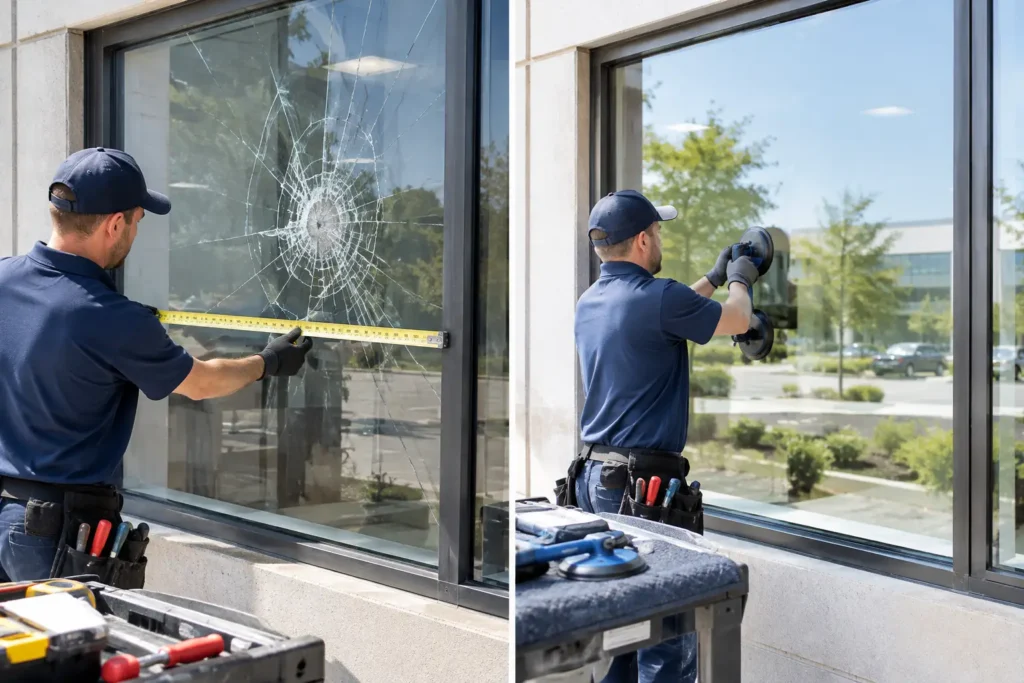
Wear cut-resistant gloves and safety glasses if the glass is cracked. Do not press on a damaged pane, remove glazing beads, or pull on loose fragments just to get a measurement. Broken glass can shift without warning, particularly in a door, lower-level window, storefront, or window sash that moves.
For every piece of glass, record the width, height, thickness, and which room or exterior elevation it belongs to. Labeling a measurement “living room left window” is much more useful than a note that says “32 x 48.”
How to Measure Replacement Window Glass in Place
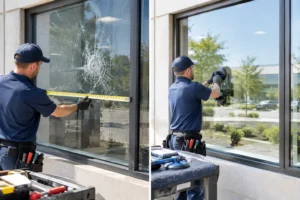
When the glass is intact and accessible, measure the exposed glass carefully. Start with the width, measuring from the left edge of the glass to the right edge, not from one side of the window frame to the other. Take this measurement in three places: near the top, center, and bottom.
Then measure the height at the left side, center, and right side. Write down the smallest width and the smallest height you find. Window frames and sashes can be slightly out of square, particularly in older homes, wood windows affected by moisture, or units that have settled over time.
Record the measurement in width-by-height order. For example, write 28 3/16 inches wide by 46 1/8 inches high. Avoid rounding up or down to the nearest whole inch. A precise measurement is far more useful when a glass company verifies the job and orders the replacement.
Do not measure only the visible daylight area if the pane disappears behind a sash, frame, or glazing stop. The actual glass extends underneath those retaining components. On many windows, an experienced glazier will need to verify the true glass size, called the tight size, by inspecting the sash and glazing system. Your exposed-glass dimensions still provide an excellent starting point for a free estimate and can speed up the process.
Measure the Thickness of the Glass Unit
Thickness is just as important as width and height. On a single-pane window, measure the edge of the glass only if it is safely exposed. Common residential glass thicknesses include 1/8 inch and 3/16 inch, but guessing is not a good idea.
For double-pane glass, measure the full insulated unit thickness from exterior glass surface to interior glass surface. Many units are around 1/2 inch, 5/8 inch, or 3/4 inch thick, though dimensions vary. If the edge is not visible, measure the depth of the unit in the sash as accurately as possible and include a close-up photo.
A unit with the wrong thickness may not sit properly in the glazing channel. That can affect weather resistance, drainage, operation, and long-term seal performance.
Check for Details That Affect the Order
Two pieces of glass can have the same dimensions but still require different replacement units. Before requesting a quote, look for identifying details on the existing glass.
First, check the lower corners for a permanent etched mark. Tempered safety glass often carries a small stamp in one corner. Tempered glass is commonly required near doors, in patio doors, bathrooms, stairways, and other impact-prone locations. It cannot be cut after tempering, so the size and safety specification must be correct before fabrication.
Next, look at the spacer between the panes. Note its color, usually silver, black, bronze, or white, and whether the unit has grids between the glass. If grids are present, take a straight-on photo and measure the grid pattern. A replacement that omits or misaligns grids can stand out immediately, even if the glass fits perfectly.
Also note whether the glass is clear, tinted, frosted, textured, low-emissivity coated, laminated, or decorative. Privacy glass in a bathroom, obscure glass beside an entry door, and coated glass designed to reduce heat transfer should be matched as closely as possible. The right replacement restores appearance as well as performance.
Measuring a Broken or Missing Pane
A broken window is not a DIY measuring project if shards remain in the opening or the sash is compromised. Keep children, pets, customers, and employees away from the area. If possible, close off the room, carefully cover the opening from the inside without pushing on loose glass, and avoid relying on tape alone to hold fragments together.
When the original glass is gone, measure the opening only if it can be done without touching damaged glazing materials or unstable frame components. Measure the width and height of the glass pocket, or rabbet, where the glass sits. Take three measurements in each direction and document the smallest dimensions. Then photograph the frame, any remaining spacer, broken glass markings, and the full window from inside and outside.
Do not order glass directly from an opening measurement unless you understand the glazing system. Frames need clearance for setting blocks, gaskets, glazing compound, and normal expansion. Ordering a pane at the exact opening size can leave you with glass that will not install safely.
For urgent damage, temporary board-up or emergency glass service is often the smarter move. It protects the property while the exact replacement is measured and fabricated.
Give Your Glass Professional the Right Information
A clear request can reduce extra visits and ordering mistakes. Along with your measurements, provide photos of the full window, close-ups of each glass corner, the spacer or edge if visible, and any etched markings. Mention whether the pane is cracked, shattered, fogged between panes, leaking air, or difficult to operate.
Include the window location, such as “second-floor bedroom facing the backyard,” plus whether it is fixed, sliding, casement, double-hung, or part of a door. For commercial properties, identify the suite, entrance, or storefront section and explain whether the damage creates a security issue or affects business hours.
Quick Glass Repairs can confirm measurements, identify the correct glass type, and explain whether same-day stabilization is available while a custom insulated unit is ordered. That verification is especially valuable for safety glass, older frames, custom shapes, and failed double-pane units.
When to Stop Measuring and Call for Help
Call a professional promptly when glass is shattered, the opening is unsecured, the window is above ground level, or the damaged pane is in a door or commercial entrance. The same applies when the frame is bent, the sash will not close, or you suspect the glass is tempered or laminated.
Fogged glass is less urgent than a broken pane, but it should not be ignored indefinitely. Failed seals reduce clarity and can affect insulation. A precise glass-only replacement may restore the window without the expense and disruption of replacing the entire frame, depending on its condition.
A careful measurement gets the repair moving. A professional verification makes sure the new glass fits, seals, and protects the property the way it should.